9/13/17 - Hurricane Jose Should Miss The U.S., but Bermuda Should Monitor

Note: At times, our team will write in-depth discussions on the tropics or systems below. Always visit the "Current Storms" section for the latest advisories and tracking maps on active systems.

The tropics in the Atlantic have thankfully quieted down a bit now that Hurricane Irma is just a remnant low over the Eastern U.S. We are still watching Hurricane Jose north of the Caribbean Islands, just meandering around due to a weak steering flow. There is some wind shear and dry air that is affecting the storm and will continue to do so the next couple days, so it may weaken into a strong tropical storm briefly, but around the end of this week it should become a hurricane again. Now when we talk about potential U.S. impacts from Jose, the chances are very low at this moment. Almost all models take the storm out to sea, although there are a few that do bring Jose into the Mid-Atlantic or New England. That’s why we’re still going to be needing to watch this storm closely just in case he follows one of those paths close to land. If Jose doesn’t make landfall on the U.S., which it shouldn’t at this time, it will still bring larger waves to the Eastern Seaboard. If you’re in Bermuda, that’s a different story because there is the potential Jose gets very close to Bermuda as a category 1 hurricane. Just monitor the forecast and we’ll be sure to keep you updated on the Hurricane Tracker App.

We’ll another update as conditions warrant on Hurricane Jose.

-- Jackson Dill, Hurricane Tracker Team 
9/10/17 - Irma Has Made Landfall In The FL Keys, But Effects Are Far From Over

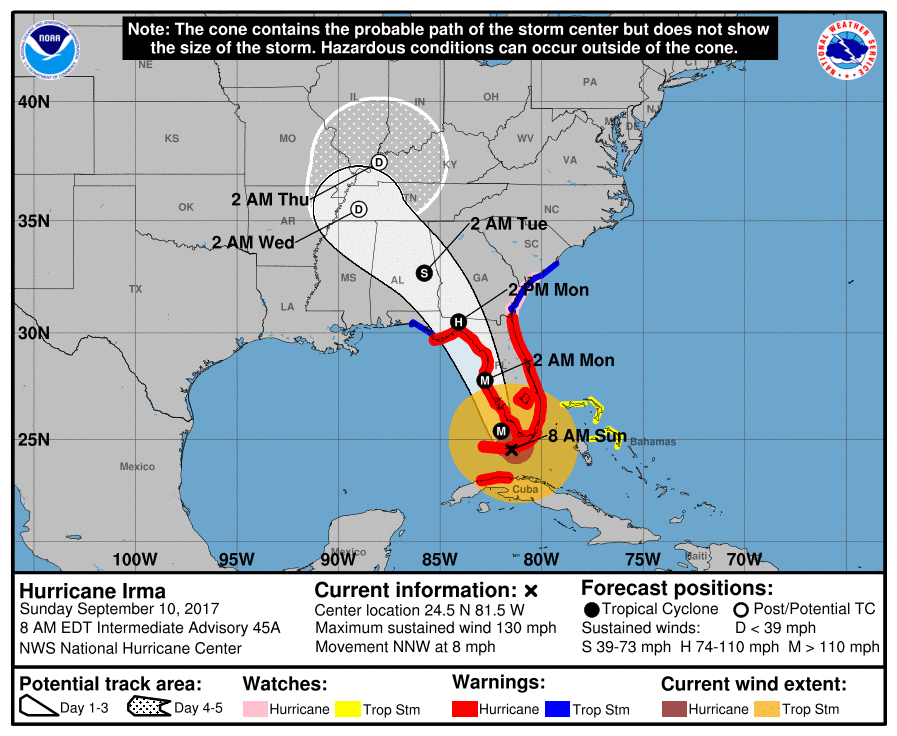
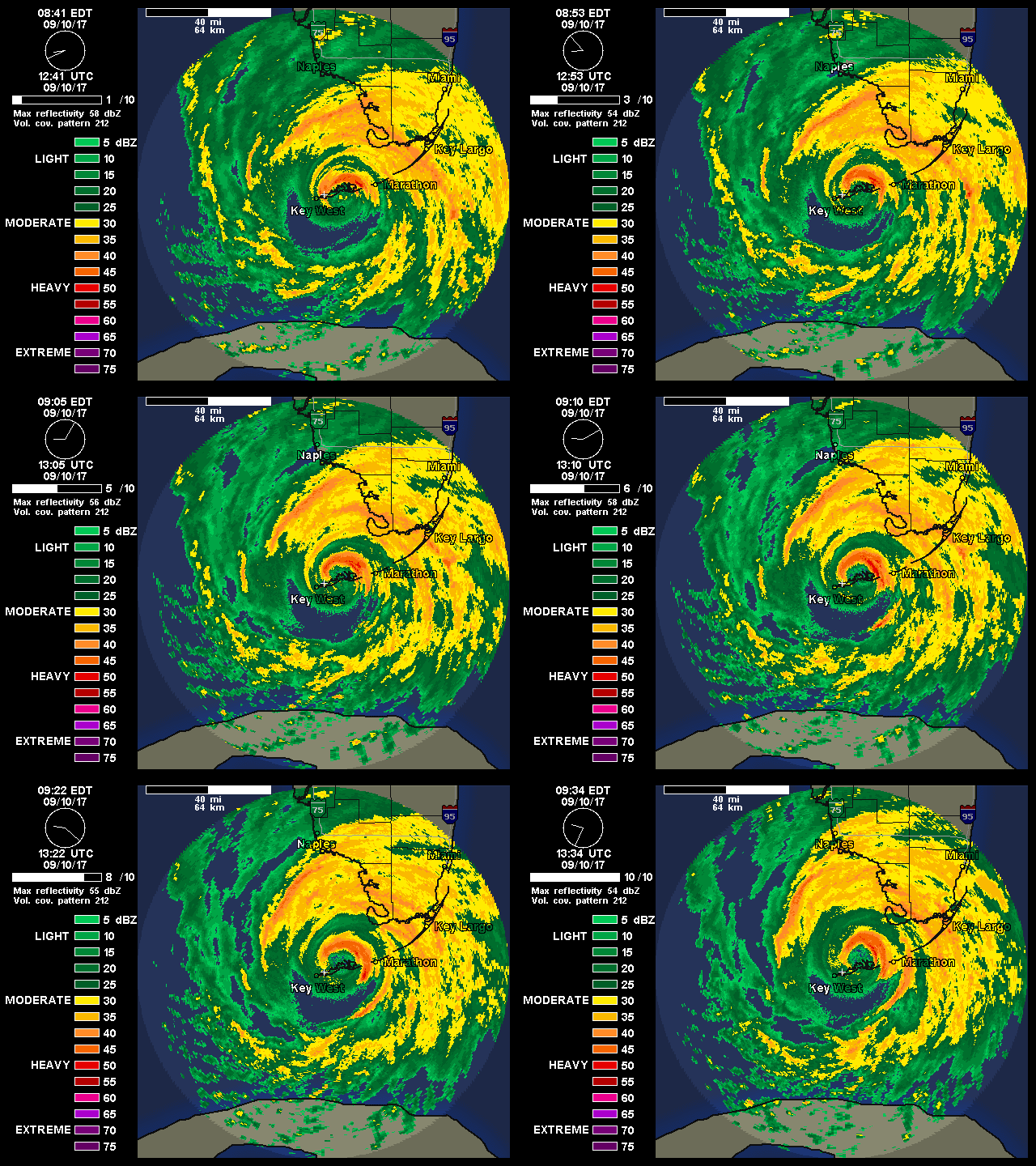
Overview: Today marks the climatological peak of the Atlantic hurricane season and also the first time 2 Category 4+ storms have made landfall in the United States in the same season. The center of Hurricane Irma made landfall at Cudjoe Key in the lower Florida Keys at 9:10 am EDT. However, the effects from Irma are far from over as this will be a multi-day event of significant impacts to the Southeast U.S. 

WUNIDS_map-3.gif

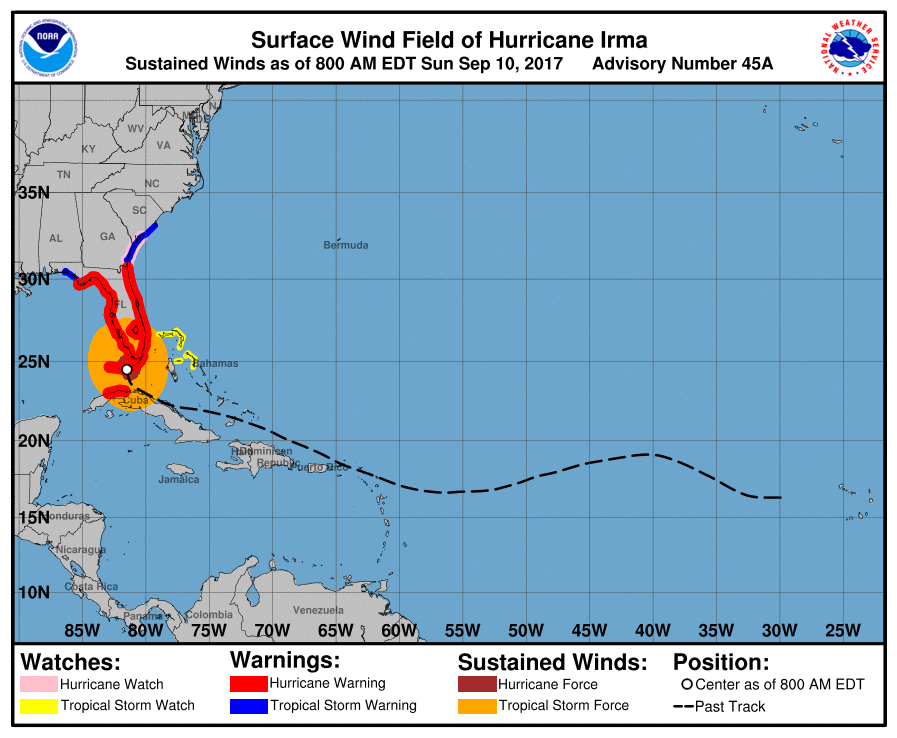
Watches/Warnings: A Storm Surge Warning is in effect for South Santee River southward to Jupiter Inlet, North Miami Beach southward around the Florida peninsula to the Ochlockonee River, Florida Keys, and Tampa Bay. A Hurricane Warning is in effect for Fernandina Beach southward around the Florida peninsula to Indian Pass, Florida Keys, Lake Okeechobee, Florida Bay, Cuban provinces of Ciego de Avila, Sancti Spiritus, Villa Clara, Matanzas, and La Habana. A Hurricane Watch is in effect for north of Fernandina Beach to Edisto Beach. A Tropical Storm Warning is in effect for west of Indian Pass to the Okaloosa/Walton County Line and north of Fernandina Beach to South Santee River. A Tropical Storm Watch is in effect for Bimini and Grand Bahama.

093910_current_wind_sm.png

Forecast: As Irma tracks up the west FL coast, it will make a second landfall in southwest Florida in the Naples area. This is the worst-case scenario for this part of the state. Southwest Florida is so prone to storm surge and they are expected to get 10 to 15 feet. The storm surge forecast maps show entire cities going underwater, like Naples, Marco Island, Fort Myers, and Cape Coral. Irma will continue to follow a northward path, basically riding the west coast of Florida. Because of how close she will still be to the water, this may allow her to maintain much of her strength as a hurricane through her life over the Florida Peninsula. We are also concerned about storm surge in Tampa Bay, where 3 to 5 feet of inundation is forecast. The large majority of the west coast of the Peninsula can expect sustained winds of at least 100 mph and gusts as high as 130 mph. Even though we’re focusing on the western half of the Florida Peninsula, this storm will very much be an eastern half event as well. The good news is that the center of Irma won’t track over the Miami area, therefore winds will be “lighter” with winds sustained up to 70 mph and gusts up to 100 mph. Much of the same is forecast for the remainder of the east coast of Florida with slightly weaker winds in the cards. 3 to 5 feet of inundation is forecast along the coast in the Miami Beach area. Further north, expect up to 4 feet of surge. The Florida Panhandle is also going to deal with impacts from Irma. Up to 3 feet of storm surge is forecast for the Big Bend of Florida with eastern portions of the Panhandle experiencing peak wind gusts of up to 90 mph. Localized flooding due to rainfall is also possible. South Florida will get the heaviest of the rain. Some locations will receive over one foot of total rainfall. With that heavy rain falling over Lake Okeechobee, there are concerns for flooding along the lake due to water levels rising. In Georgia, strong winds and heavy rains are the main risks. Winds may gust up to hurricane-force as far north as Atlanta. Rainfall totals may top 8 inches in southern Georgia. Along the coast, which is where all residents are ordered to evacuate, significant storm surge is possible. South Carolina will also deal with gusty winds up to 50 mph and storm surge expected as far north as Charleston in the range of 3 to 6 feet. As Irma moves further north, it will considerably weaken into a remnant low early next week as most of the rain dissipates and the winds calm down.

To view exactly how storm surge may impact your location, check out the National Hurricane Center’s storm surge inundation maps here:

http://www.nhc.noaa.gov/refresh/graphics_at1+shtml/035210.shtml?inundation#contents

Conclusion: Hurricane Irma will be a historic storm, impacting Florida in a way we have never seen before. Irma is massive with hurricane-force-wind spanning over 70 miles away from its center and tropical storm force winds 200 miles from the center. Much of the FL peninsula will experience hurricane force winds. We will have another update on Hurricane Irma as conditions warrant. Thanks for using our service.

-Jackson Dill, Hurricane Tracker App Team